

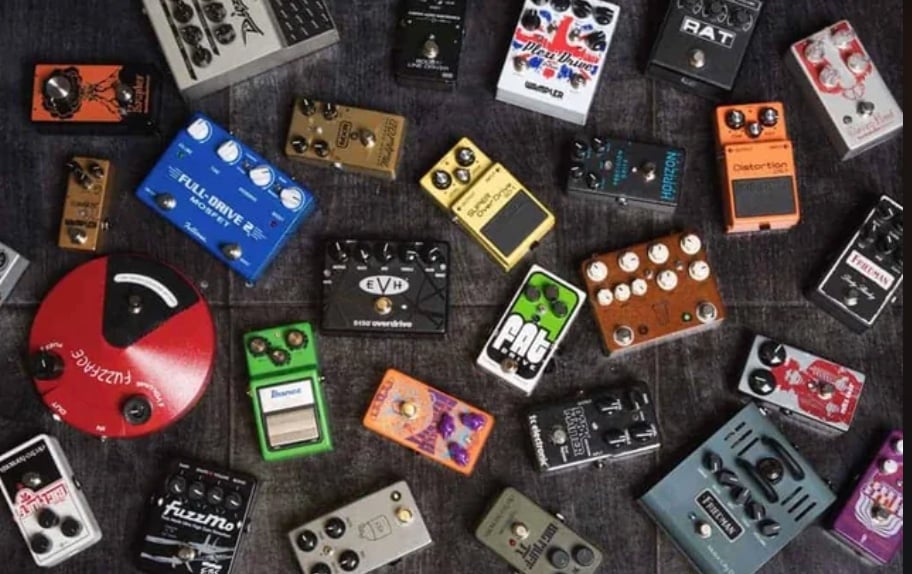
Few effects have as much impact on tone as saturation pedals. They are the backbone of rock, metal, punk, stoner, blues, and practically any style that relies on weight and intensity. Let’s break down each one and explore some of the less talked-about variations.
⚡ Overdrive – The Classic Crunch
- Sound: simulates the natural “clipping” of tube amps pushed at high volume.
- Character: smoother and more dynamic, responds well to picking intensity.
- Where it shines: blues, classic rock, country.
- Iconic examples: Ibanez Tube Screamer, Boss SD-1.
🔥 Distortion – Power and Attack
- Sound: more compressed and aggressive than overdrive, with extended sustain.
- Character: creates that “wall of sound,” perfect for heavy riffs.
- Where it shines: hard rock, metal, punk, grunge.
- Iconic examples: Boss DS-1, ProCo Rat, MXR Distortion +.
🌋 Fuzz – The Raw and Dirty Sound
- Sound: extreme distortion, often square-wave-like, packed with harmonics.
- Character: chaotic, dirty, with a strong identity.
- Where it shines: psychedelic, stoner rock, doom metal.
- Iconic examples: Electro-Harmonix Big Muff, Dallas Arbiter Fuzz Face.
💡 Fun fact: Fuzz was born by accident in the ’60s, when engineers tried to fix a faulty amp channel that ended up becoming the signature tone of “(I Can’t Get No) Satisfaction” by The Rolling Stones.
🌌 Lesser-Known Variations and Derivatives
- Modern High Gain: pedals that emulate metal amp heads, with tons of gain and tight low end (Mesa Boogie Throttle Box, EVH 5150 Overdrive).
- Bass Distortion: many pedals include a blend circuit to mix clean tone and preserve definition (Electro-Harmonix Bass Big Muff, Darkglass Alpha Omega).
- Octave Fuzz: combines fuzz with octave-up/down for psychedelic tones (Octavia, EarthQuaker Hoof Reaper).
- Velcro / Gated Fuzz: cuts sustain, creating a “chopped” or glitchy feel → often used in experimental music (ZVEX Fuzz Factory).
🎶 How to Use in Your Setup
- Overdrive before distortion → adds punch and definition (classic solo boost).
- Fuzz at the start of the chain → reacts best to raw guitar signal.
- Stacking drives → running multiple gain pedals in series opens up endless combinations (e.g., low gain + high gain).
- On bass → always handy to use a blend or EQ to avoid losing low-end punch.
✨ Conclusion
Overdrive, distortion, and fuzz are more than just pedals: they define the character and aggression of your tone. From vintage crunch to total sonic chaos, each saturation stompbox carries its own musical identity.
👉 And of course, at Stompbox Store you’ll find everything from classics like the Big Muff to modern monsters from Darkglass and experimental boutique fuzz pedals.